

In this guide
- Define who owns each type of request
- Separate an answer from a task
- Send enough information for the team to act
- An example task brief the team can use
- Track acknowledgement and completion separately
- Set escalation around the hotel operation
- Test the awkward cases before launch
- Review the whole request journey
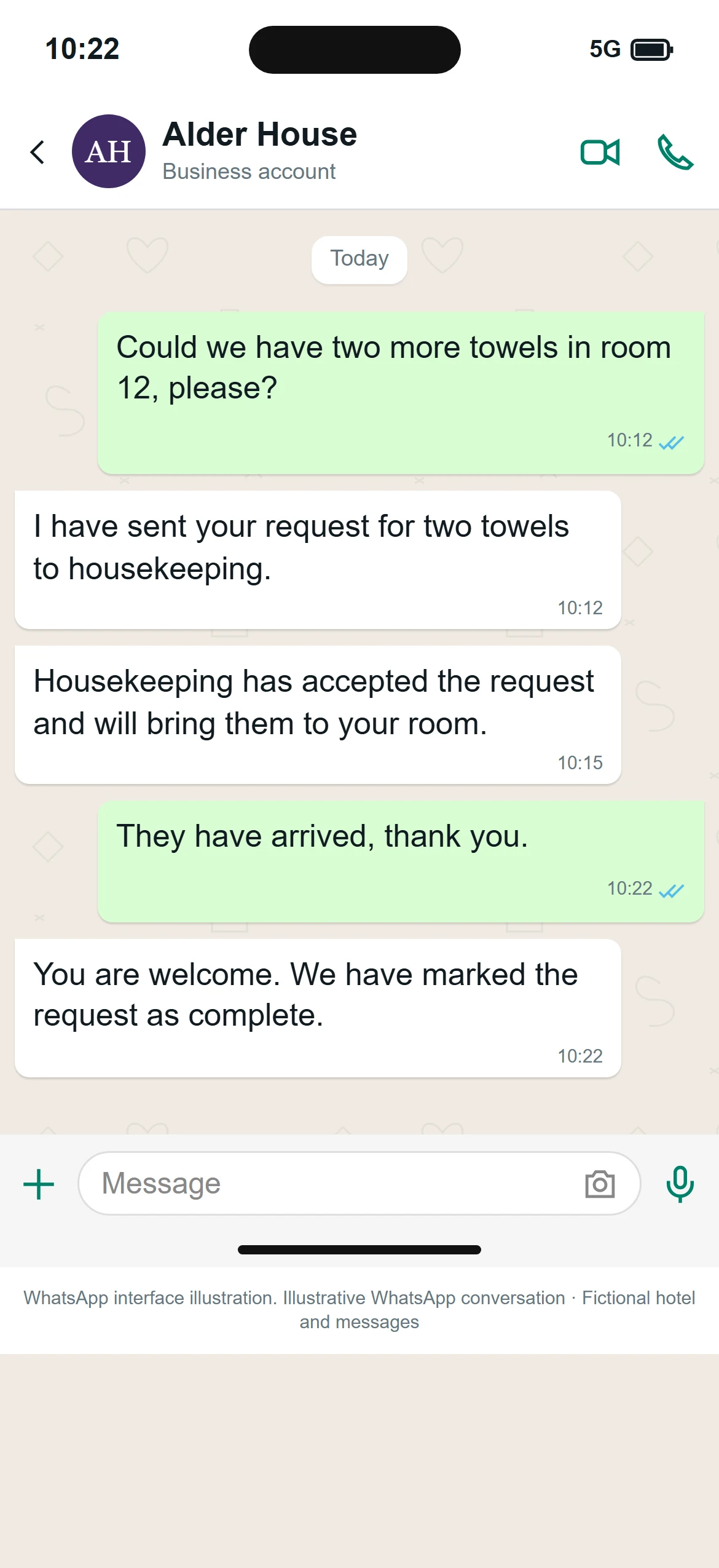
A guest asks for fresh towels through the hotel's messaging service. An immediate reply acknowledges the request. Someone still needs to receive the task, take responsibility and deliver the towels.
Hotel AI handover should connect the guest's message to a named team or role, pass on the relevant details and track the request until there is a known outcome. Reception needs visibility when the responsible department cannot respond. The guest should hear what has actually happened at each stage.
Define who owns each type of request
Begin with the hotel's current operation. Housekeeping may already work from a department phone. Maintenance may receive jobs through a different system. Overnight, reception may cover both.
Build routing around those arrangements. A category alone is insufficient: “housekeeping” needs an owner on the shift, a route to reach them and a fallback when they are unavailable.
Write down what happens when a request crosses departments. A cot may require housekeeping to prepare the room and reception to check suitability. Decide who coordinates the work so the guest does not receive several conflicting replies.
Separate an answer from a task
Opening times and directions often need an accurate answer. A request to repair an air-conditioning unit needs a task. A late checkout request requires a decision based on the hotel's availability and policy.
| Guest message | Appropriate next step |
|---|---|
| What time does breakfast finish? | Answer from the hotel's current information |
| Could we have two more towels? | Send a room-specific task to housekeeping |
| The shower is leaking | Route to the responsible team and apply the hotel's urgency rules |
| Can we stay in the room until 1pm? | Ask the authorised team to check and confirm |
The distinction affects the wording. “I have passed that to housekeeping” describes a handover. “The towels are on their way” requires evidence that someone is taking them.
Send enough information for the team to act
A useful task includes the request, location, time received and any detail that changes what staff need to do. For towels, the quantity matters. For a fault, the room and the guest's description matter.
Avoid requiring staff to read an entire conversation before understanding the job. Provide a short summary and a route to the relevant context where needed. Limit access to the people who need that information.
If the room is uncertain, confirm it before dispatching the task. Requests can come from someone organising several rooms or from a guest whose booking details have changed. Match the request to the current stay rather than relying on an old room number.
An example task brief the team can use
For a fictional towel request at Alder House, the staff notification could contain:
| Field | Example |
|---|---|
| Location | Room 12, current stay checked |
| Request | Two additional bath towels |
| Received | 10:12 through guest messaging |
| Owner | Housekeeping on the current shift |
| Guest update | Request passed to housekeeping |
| Next action | Accept the task, then record delivery |
| Fallback | Reception if the department cannot accept it |
The hotel should set its own escalation threshold. Keep that threshold visible to the responsible team.
The guest-facing acknowledgement can be simple: "I have passed your request for two towels to housekeeping." Once someone accepts the task, the update can describe that next stage. This keeps the guest's understanding aligned with the staff record.
Track acknowledgement and completion separately
Three states are useful in many hotel workflows: received, accepted by the team, and completed. A fourth state for waiting or blocked work can help when staff need a part, access to the room or a guest decision.
Each state needs a clear meaning. Reading a notification should not automatically mark the work complete. A staff member saying “done” should close the correct task, especially where a room has more than one open request.
Agree which changes the guest should see. A short confirmation after completion may be enough for a routine request. A delayed repair may need a progress update and a person to discuss the alternatives.
Set escalation around the hotel operation
Decide what happens when nobody accepts the task or staff cannot complete it. Use thresholds appropriate to the request and staffing pattern, rather than applying the same timer to every department.
Urgent welfare or safety concerns need the hotel's established emergency process. A chat service should make the route to immediate help clear and avoid presenting routine task routing as emergency response.
WhatsApp's policy requires clear escalation routes when automation is used. That might include an in-chat handover, a telephone number or another direct support route. The hotel still needs to decide how those routes are staffed. WhatsApp Business Messaging Policy.
Test the awkward cases before launch
Ask a member of each team to test a request arriving during a shift change, a duplicated message, a wrong room number and a task that cannot be completed. Include a guest who changes their mind after the job has been assigned.
Check what happens if the department phone is offline. Confirm that the fallback reaches someone responsible and that the guest receives an accurate update. Run through what reception sees when a guest calls about an existing request.
Review the whole request journey
Useful measures include how many requests reached the correct team, how many were accepted, how many were completed and which needed escalation. Record unresolved work at the end of the reporting period rather than silently dropping it.
An automated acknowledgement does not establish delivery or time saved. Those outcomes need their own records and definitions.
Biteluxe builds guest request workflows around the hotel's departments and SOPs. Start with one request that currently passes through reception several times. Map every handover and decide what each person needs to see before adding automation.